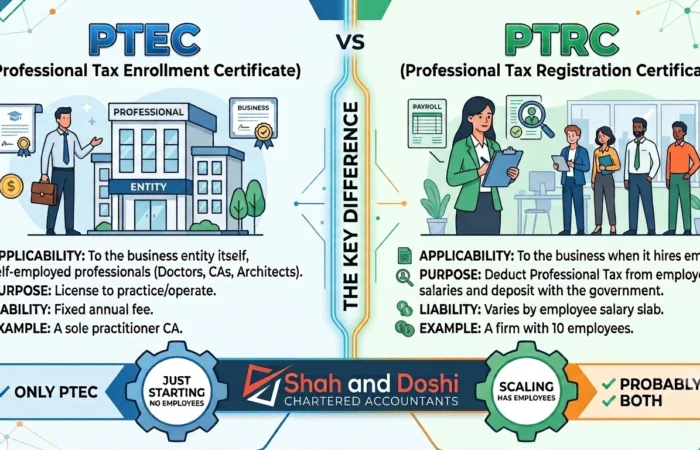
PTEC Vs PTRC: What Is the Difference and Which One Does Your Business Actually Need?
If you are planning to start a business or have recently begun hiring employees, you are likely to come across terms such as PTEC and PTRC. Since both are related to Professional Tax, many business owners assume they mean the same thing. They serve different purposes and apply to different compliance requirements. Understanding this difference is essential to ensure your business follows the applicable state regulations from the beginning.
One of the most common mistakes businesses make is registering under the wrong category or believing that a single registration is enough. This can result in compliance issues, delays, additional paperwork, or even penalties. The registration your business requires depends on factors such as your business structure, the nature of your operations, and whether you have employees from whom Professional Tax must be deducted.
Whether you are a sole proprietor, a partnership firm, a company, or have recently completed LLP registration, knowing the role of each registration can help you stay compliant and avoid unnecessary complications.
In this blog, we explain the PTRC full form, the key differences between PTEC and PTRC, when PTEC registration or PTRC registration is required, and how to determine which option best suits your business.
What Is PTEC?
PTEC stands for Professional Tax Enrolment Certificate. It applies to professionals, businesses, firms, companies, and individuals who are liable to pay Professional Tax on their own behalf.
A business owner, freelancer, partnership firm, or company may require PTEC registration depending on the applicable state laws.
In simple terms, PTEC is about paying your own Professional Tax liability.
Examples include:
- Proprietors running a business
- Self-employed professionals
- Partnership firms
- Private limited companies
- Directors and designated partners where applicable
Having PTEC registration helps ensure that your business meets its Professional Tax obligations without delays.
What Is PTRC?
The PTRC full form is Professional Tax Registration Certificate. It is a registration that applies to employers who are responsible for deducting Professional Tax from the salaries or wages of eligible employees and depositing it with the respective state government.
Unlike PTEC, which relates to the Professional Tax liability of a business or professional, PTRC is specifically linked to your role as an employer. If your business has employees whose salaries fall under the applicable Professional Tax rules, obtaining PTRC registration is a legal requirement.
Once you complete PTRC registration, you are responsible for several ongoing compliance activities, including:
- Deducting Professional Tax from the salaries of eligible employees based on the applicable state slab.
- Depositing the tax collected with the government within the prescribed timelines.
- Filing Professional Tax returns accurately and before the applicable due dates.
- Maintaining proper records of employee deductions and tax payments for future reference.
It is important to remember that PTRC is not a one-time registration. It comes with regular compliance responsibilities that continue as long as your business employs staff who are liable for Professional Tax.
Whether you run a small business, an LLP, a partnership firm, or a growing company, PTRC registration becomes essential once you start employing people and are required to deduct Professional Tax from their salaries. Along with obtaining the registration, businesses should also keep track of the PTRC return due date to ensure returns are filed on time and to avoid penalties or notices from the authorities.
Understanding the purpose of PTRC helps employers meet their statutory obligations while ensuring that employee tax deductions are managed accurately and in accordance with the applicable regulations.
Key Differences Between PTEC And PTRC
Although both registrations relate to Professional Tax, their purpose is different.
- PTEC applies to your own Professional Tax liability.
- PTRC applies when you deduct Professional Tax from employee salaries.
Another important difference is compliance.
Businesses holding PTRC must keep track of deductions, payments, and filing requirements. They also need to monitor the PTRC return due date to avoid late fees or penalties.
In many cases, businesses require both registrations because they pay Professional Tax for themselves and also deduct it from employees.
Understanding this distinction helps avoid unnecessary compliance issues later.
Does Your Business Need One or Both?
The answer depends on how your business operates.
You may only need PTEC registration if:
- You are a sole proprietor without employees.
- You are a self-employed professional.
- Your business has no salary deductions to manage.
You may need only PTRC registration if:
- You act solely as an employer required to deduct Professional Tax from employees under state regulations.
Many businesses require both PTEC and PTRC if they:
- Operate as companies or LLPs.
- Employ staff.
- Have their own Professional Tax liability.
- Deduct Professional Tax from employees.
For growing businesses, reviewing your compliance regularly is important because registration requirements may change as your workforce expands.
Why Timely Compliance Is Important
Obtaining the correct registration is only the beginning of Professional Tax compliance. Once your business has completed PTEC registration or PTRC registration, it is equally important to meet all ongoing compliance requirements. Regular payments, accurate record-keeping, and timely return filing help ensure that your business remains compliant with state regulations.
For employers, one of the most important responsibilities is monitoring the PTRC return due date. Missing a filing deadline can lead to penalties, interest, and notices from the authorities. Even if the tax amount is correctly calculated, late filing can still result in avoidable compliance issues.
Maintaining a proper compliance routine not only helps businesses meet their legal obligations but also reduces the risk of errors during audits or inspections. It also creates a clear record of tax payments and filings, making future compliance much easier to manage.
Some good compliance practices include:
- Maintaining accurate employee records to ensure the correct Professional Tax is deducted.
- Reviewing salary deductions regularly, especially when employees join, leave, or receive salary revisions.
- Paying Professional Tax within the prescribed timelines to avoid interest and penalties.
- Filing returns well before the PTRC return due date instead of waiting until the last moment.
- Updating registration details whenever there are changes to the business name, address, ownership structure, or employee strength.
Following these practices helps businesses stay organised and compliant throughout the year. Rather than treating Professional Tax as a one-time requirement, it should be viewed as an ongoing responsibility. Regular compliance not only helps avoid disruptions and unnecessary penalties but also ensures that your statutory records remain accurate and up to date.
How LLP Registration Connects with Professional Tax
Many entrepreneurs’ complete LLP registration as one of the first steps towards starting a business. While incorporating an LLP gives your business a legal identity, it does not automatically complete all the tax registrations required to operate compliantly. Professional Tax is a separate legal requirement and should be reviewed soon after your LLP is formed.
Here are some important points to understand:
- LLP registration and Professional Tax registration are separate legal compliances. Completing one does not automatically satisfy the other.
- After LLP registration, the LLP should determine whether PTEC registration is applicable. If the LLP is liable to pay Professional Tax in its own capacity, obtaining PTEC registration is necessary.
- If the LLP employs staff whose salaries fall under the applicable Professional Tax rules, it may also require PTRC registration. This enables the LLP to deduct Professional Tax from employees and deposit it with the government.
- Businesses that hold PTRC registration must also monitor every PTRC return due date. Timely filing of returns is an essential part of ongoing compliance and helps avoid penalties.
- Many newly incorporated LLPs assume that completing LLP registration is enough to meet all statutory requirements. However, Professional Tax registrations should be assessed separately based on the nature of the business and the number of employees.
- As your LLP grows, your compliance requirements may change. An LLP that initially required only PTEC registration may later need PTRC registration after hiring employees.
- Completing all applicable registrations at the beginning helps create a smoother compliance process. It also reduces the chances of missing important legal obligations as the business expands.
- Keeping all registrations up to date and reviewing them regularly ensures that your LLP remains compliant with changing business activities and regulatory requirements.
By reviewing Professional Tax requirements immediately after LLP registration, businesses can avoid unnecessary delays, reduce compliance risks, and build a strong foundation for future growth. A proactive approach to PTEC registration and PTRC registration helps ensure that all statutory obligations are met from the very beginning.
Common Mistakes Businesses Should Avoid
Professional Tax compliance is generally straightforward, but many businesses still make mistakes that can lead to notices, penalties, or unnecessary delays. Most of these issues arise because business owners are not fully aware of the different registration requirements or ongoing compliance responsibilities.
Here are some of the most common mistakes to avoid:
- Assuming PTEC and PTRC are the same registration
Although both relate to Professional Tax, they serve different purposes. PTEC is for paying your own Professional Tax liability, while PTRC is required for employers who deduct Professional Tax from their employees.
- Applying for only one registration when both are required
Many companies complete only one registration without checking whether they also need the other. Businesses with employees often require both PTEC and PTRC to remain fully compliant.
- Missing the PTRC return due date
Filing returns on time is just as important as obtaining the registration. Keeping track of every PTRC return due date helps businesses avoid late fees and penalties.
- Delaying PTEC registration after starting business operations
Some business owners postpone PTEC registration, believing it can be completed later. However, obtaining the registration at the right time helps ensure compliance from the beginning.
- Ignoring Professional Tax compliance after LLP registration
Completing LLP registration is only one part of setting up a business. If the LLP is liable for Professional Tax or employs staff, it should also review whether PTEC registration or PTRC registration is required.
- Failing to update registrations when business details change
Changes such as a new business address, legal structure, or increase in employee strength may require updates to your Professional Tax records. Keeping registration details up to date helps avoid compliance issues in the future.
By understanding these common mistakes and taking timely action, businesses can manage their Professional Tax obligations more efficiently, reduce the risk of penalties, and ensure smooth day-to-day compliance.
Take The Right Step from the Beginning
Understanding the difference between PTEC and PTRC is an important step towards managing your business compliantly. While PTEC applies to your own Professional Tax liability, PTRC is required if your business deducts Professional Tax from employees’ salaries. Depending on the size of your business, its legal structure, and the number of employees you have, you may need one or both registrations.
Simply obtaining the registrations is not enough. Businesses must also ensure timely tax payments, monitor every PTRC return due date, and maintain accurate records to meet their ongoing compliance obligations. Whether you are starting a new venture, expanding your workforce, or have recently completed LLP registration, reviewing your Professional Tax requirements at the right time can help you avoid unnecessary delays, penalties, and compliance issues.
Having a clear understanding of the PTRC full form, completing PTEC registration or PTRC registration wherever applicable, and keeping up with regular filings allows your business to operate with confidence. A proactive approach to compliance also makes it easier to manage future business growth without worrying about missed legal requirements.
At Shah Doshi, we believe that tax compliance should be simple, practical, and stress-free. We work closely with businesses to help them understand their Professional Tax obligations and complete the necessary registrations accurately. Whether you need support with PTEC, PTRC, registration, compliance after LLP registration, or ongoing Professional Tax filings, we are here to guide you at every stage. Our team focuses on providing reliable advice and timely assistance, helping your business stay compliant so you can focus on running and growing it with confidence.